PRISMA flow diagram and reporting guideline
PRISMA (Preferred Reporting Items for Systematic Reviews and Meta-Analyses) is the most widely used reporting guideline for systematic reviews and meta-analyses. The current version, PRISMA 2020, consists of a 27-item checklist and a flow diagram, and applies across research fields (not just health/medicine, where it originated).
The official checklist, flow diagram templates, and supporting documents are maintained at prisma-statement.org.
The flow diagram
The flow diagram documents, stage by stage, how the initial pool of records became the final set of included studies — the same searching and selecting process described in the meta-analysis steps:
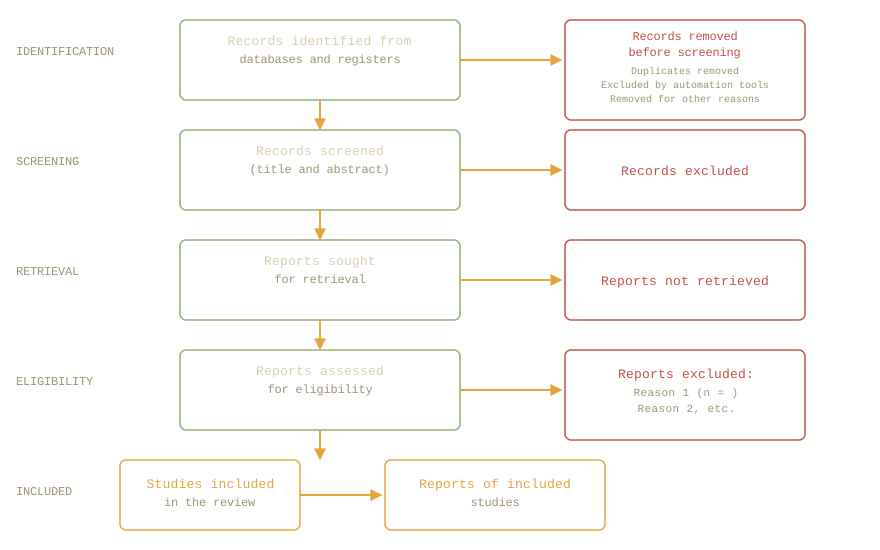
- Identification: how many records were found (databases and registers), and how many were removed before screening — split into duplicates, records excluded by automation tools, and records removed for other reasons.
- Screening: how many records were screened (title/abstract) and how many were excluded at this stage.
- Retrieval: how many reports were sought for retrieval, and how many could not be retrieved.
- Eligibility: how many reports were assessed for eligibility, and how many were excluded — with each exclusion reason reported and counted separately (reason 1, reason 2, etc.).
- Included: how many studies were ultimately included in the review, and how many reports (publications) those studies correspond to — a single study can have multiple reports (e.g. a trial published across several papers), so the two counts can differ.
Reporting exact counts at every stage is what lets readers judge how selective — and how reproducible — the search and selection process was.
Checklist and extensions
Beyond the flow diagram, the PRISMA checklist covers reporting items across the whole manuscript — title, abstract, methods, results, discussion, and funding/registration — not just the search process. Several extensions adapt the base checklist to specific designs.
Where PRISMA fits
PRISMA is one of several reporting guidelines a meta-analysis can follow, alongside APA's MARS (Meta-Analysis Reporting Standards) and MOOSE (for meta-analyses of observational studies) — see Publishing a meta-analysis for how they relate.
The diagram above is redrawn, in this site's own style, from: Page MJ, McKenzie JE, Bossuyt PM, Boutron I, Hoffmann TC, Mulrow CD, et al. The PRISMA 2020 statement: an updated guideline for reporting systematic reviews. BMJ 2021;372:n71. doi: 10.1136/bmj.n71. Licensed under CC BY 4.0.