Aggregating effect sizes
After having computed an effect size for each study — an effect size and its variance for each of k studies, as covered in Computing effect sizes — it is possible to combine them into a single overall effect size using a statistical model.
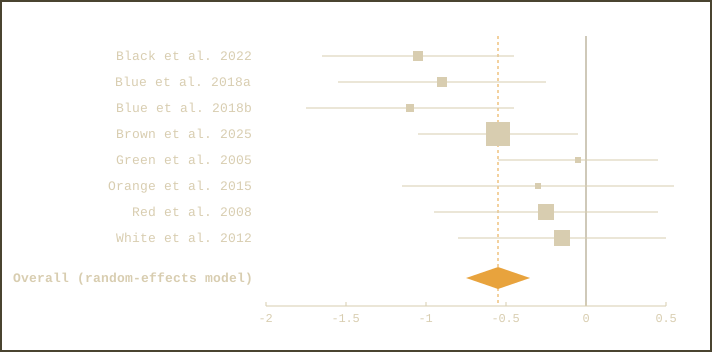
The available models differ only in which sources of variance they account for when weighting each study.
Fixed-effect model
The fixed-effect model assumes there is one true effect size shared by every study — any difference between studies is treated as sampling error. Every effect size is weighted by the inverse of its variance, so more precise studies (larger samples, smaller variance) count more. This inverse-variance weighting scheme for combining estimates across studies goes back to Cochran (1954) — see the reference list for further reading:
The pooled effect is the weighted mean, and its own variance is the inverse of the summed weights:
Random-effects model
When the assumption of one shared true effect doesn't hold — studies differ enough in population, intervention, or setting that each is estimating its own true effect — the random-effects model adds a between-studies variance component, τ². It is estimated here with the method introduced by DerSimonian & Laird (1986), the most widely used way to fit this model — see the reference list for further reading:
Each study's weight then also accounts for τ², shrinking the influence of very large studies relative to the fixed-effect model:
Both models above use the inverse-variance method for weighting; for dichotomous data with few events or small studies, the Mantel–Haenszel method is a more stable alternative.
Choosing between them
- Use the fixed-effect model only when there is a substantive reason to believe every study estimates the same true effect (e.g., tightly controlled replications) — in practice, this is rare.
- Default to the random-effects model whenever studies differ in ways that could plausibly shift the true effect — this is the common choice in most fields, since it also allows generalizing findings beyond the exact studies included in the synthesis.
See Heterogeneity for how to test whether the fixed-effect assumption actually holds, before deciding between the two models above.
Once the overall effect size is computed, it's worth checking how much it depends on any single study — a leave-one-out sensitivity analysis recomputes the pooled effect with each study removed in turn, one at a time. A study whose removal noticeably shifts the result (typically flagged by a standardized residual larger than 2 in absolute value) is a potential outlier worth a closer look, not necessarily a reason for exclusion.
The result of this step is a single overall effect size with its own variance and confidence interval — the meta-analysis's main answer to the research question, and the estimate whose disagreement across studies is examined next in Assessing heterogeneity.
Beyond one effect size per study
There's also a multilevel model, designed for the case where a study contributes more than one effect size to the analysis (e.g., several outcomes or timepoints from the same sample) — see Multilevel models to explore it further.