 ActiLab.eu
ProMeta 4
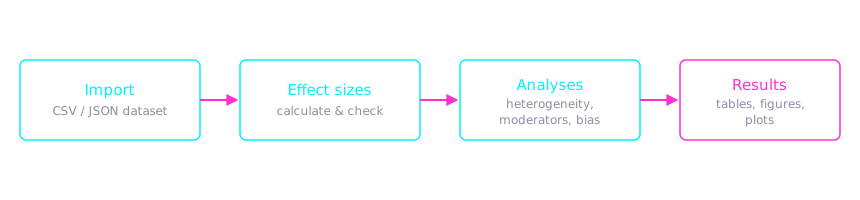
ProMeta is a free, open-source suite for meta-analysis. Its main tool is a browser application: import a dataset, run analyses, and get results ready for your manuscript or report — tables, figures, and plots. No installation, no account, and your data never leaves your machine.
ProMeta is open now Free entry, 24/7
Beta — ProMeta 4 is in public beta and not ready for production. Check every result independently before relying on it (see License and responsibility). Report anything odd at info@actilab.eu
If you used ProMeta 3, the Java desktop application, this is its successor: see Coming from ProMeta 3.
What is in the suite
One suite, one shared engine, one release cycle. The app opens on a launcher with these areas:
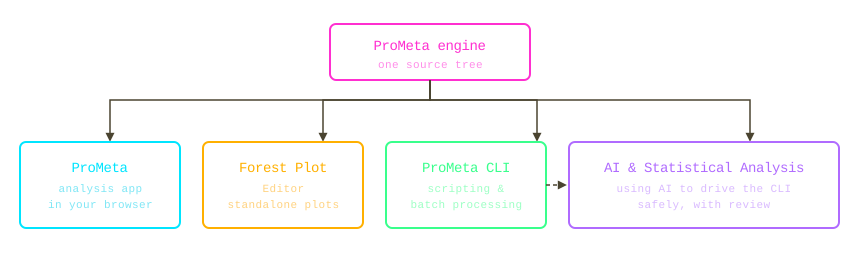
- Meta-Analysis Workspace: the main area. Studies, outcomes, subgroups, comparisons, timepoints, moderators, datasets and analyses, saved in your browser and exportable as
.prometaproject files. - Forest Plot Editor: build and edit a forest plot by hand, without a project.
- Funnel Plot Editor: build and edit a funnel plot from a table of studies.
- Scatter Plot Editor: a meta-regression scatter plot with its regression line.
- Radial Plot Editor: a radial (Galbraith) plot with its confidence cone.
- Cohen's Kappa Calculator: inter-rater agreement for two raters, unweighted or weighted. Nothing is saved.
- ProMeta CLI: the same engine on the command line, built from source, for scripting and batch processing.
For what AI can and cannot do around a meta-analysis, see AI and statistical analysis.
Features
Data ProMeta handles
- Data types: means, correlations (Pearson's r, Kendall's tau, Spearman's rho), binary data, incidence rates, and survival data (hazard ratios).
- Study designs: independent or matched groups, cross-sectional or longitudinal.
- Effect sizes: Cohen's d, Hedges' g, unstandardized mean difference, Pearson's r, Fisher's Z, odds ratio, risk ratio, risk difference, rate ratio, hazard ratio (and their log-transformed forms).
- Complex nested data: a single study can contribute multiple subgroups, comparisons, timepoints, and outcomes. ProMeta keeps that structure intact instead of forcing one row per study.
- Moderators: categorical or numerical, at the study, subgroup, comparison, or outcome level, with recoding.
Models
- Fixed-effect and random-effects models, with the Knapp-Hartung adjustment for random effects.
- Multilevel models for several effect sizes per study (see Multilevel models), including correlated-effects variants.
- Cluster-robust variance (CR1, CR2, CR3) to keep inference valid with dependent effects.
Analyses
- Pooling and heterogeneity: summary effect, heterogeneity (Q, tau², I²), prediction interval.
- Robustness: leave-one-out sensitivity, case-deletion influence diagnostics, cumulative meta-analysis, pre-analysis by subgroup, comparison, timepoint or outcome.
- Moderators: effects by level of a categorical moderator, meta-regression on one or several moderators (with interactions), permutation tests, cumulative analysis ordered by a moderator. See Moderators and meta-regression.
- Publication bias: fail-safe N, Egger's test, PET-PEESE, Begg and Mazumdar, Peters, time-lag bias, trim-and-fill, selection models, Copas, and limit meta-analysis. See Evaluating publication bias.
Results come as tables and, where relevant, as editable SVG plots (forest, funnel, scatter, radial). Every formula is documented with its citation inside the app.
Getting your data in and out
- Import: source datasets from CSV and JSON, with schema and range checks.
- Convert: between source CSV and
.prometaproject files. Exporting to CSV keeps the dataset only; analyses, filters and other project data are not included, and the app says so. - Moving from ProMeta 3:
.prmfiles from the Java application can be imported, in the app and with the CLI. See Coming from ProMeta 3.
Your data stays yours
Your dataset, calculations, and plots are stored locally in your browser and are never uploaded to an ActiLab server. See Data & Security for why this matters for research data specifically.
Who it's for
Researchers and students running a systematic review with meta-analysis who need a fast, dependable path from raw study data to manuscript-ready results, without paying for or installing desktop statistical software.
Coming from ProMeta 3
ProMeta 4 is the successor of the Java desktop application. The statistical engine was rebuilt and now runs entirely in the browser: no Java, no installation, no operating-system compatibility issues. Your old work is not lost: the app's import tool and the CLI command import-pm3 read legacy .prm files and convert them to a source CSV and a modern .prometa project (recodes, dataset definitions and analysis definitions are carried over where they can be represented).
License and responsibility
ProMeta is open source, licensed under the GNU Affero General Public License v3.0 or later; the source of every release is available from all releases. The name "ProMeta" is a trademark and is not covered by the license.
The software is provided without warranty. Results must be independently verified before use, and ProMeta must not be the sole basis for clinical, scientific, legal, financial or safety-critical decisions.